

Rebirth of ImagineLab Art: One Workspace for the Entire Creative Journey
The global rebirth of ImagineLab Art took place on, August 14, 2026. The platform brings together image creation, video, music, voice, writing, infographics, community features, flexible credit pricing, and an expanding model lineup into a single workspace.
Consider how digital creators typically manage their workflows today. One app handles image generation, another produces video, a third generates voiceovers, and separate subscriptions cover music and writing tasks. This setup forces creators to juggle multiple subscriptions, credit limits, file downloads, format conversions, and dashboard switches. Over time, managing software tools begins to take more energy than actual creative work. ImagineLab Art was rebuilt to solve this issue by consolidating a fragmented production stack into one unified platform.
The service entered beta testing on August 4, 2026, before opening globally ten days later on August 14. Thousands of creators registered during the initial beta phase, including a substantial percentage of users from major international markets.
For ImagineLab Art, this rollout is about more than acquiring early user sign-ups. It serves as a real-world test to determine whether a single creative environment can successfully replace the separate tools that freelancers, marketers, publishers, agencies, and small teams currently pay for.
The promise is straightforward: One account. One credit balance. One connected production environment.
One Workspace Replacing Dozens of Open Tabs
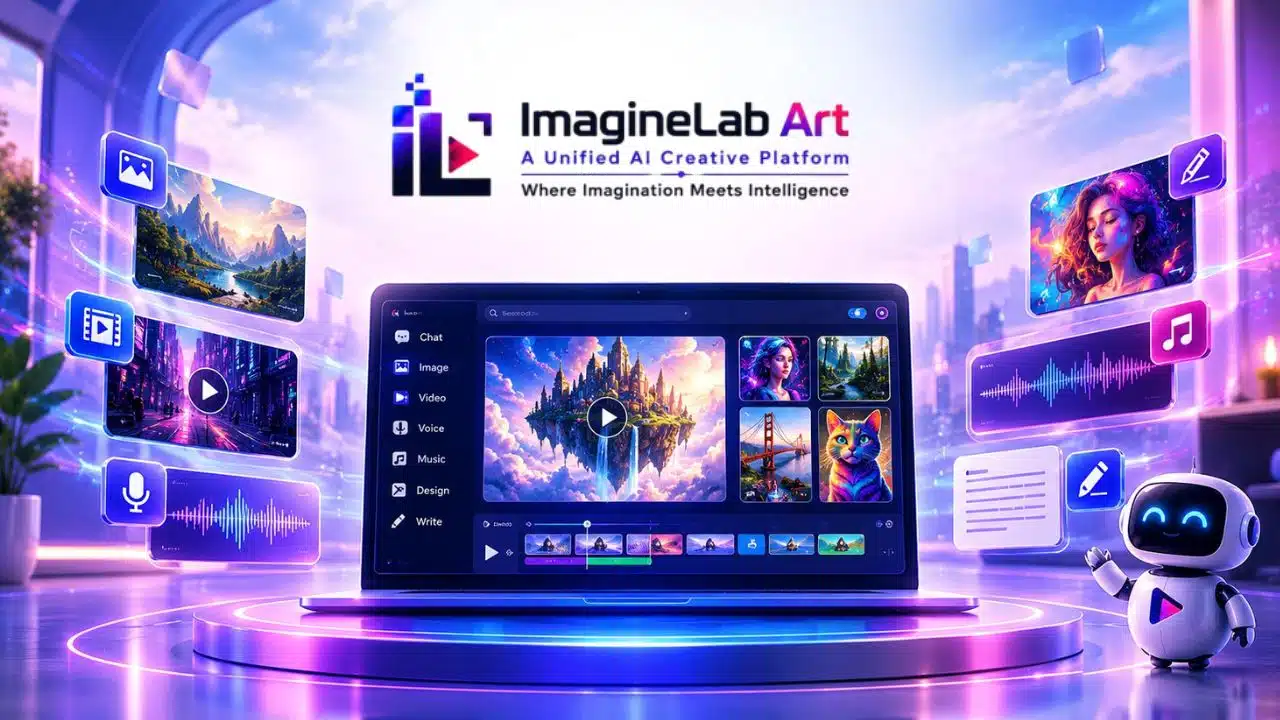
ImagineLab Art organizes its creative capabilities across seven specialized labs, with plans to introduce three more in the future. Its broader product scope encompasses image creation, video production, conversational AI, music, voiceovers, writing, infographics, long-form video, music video production, and advertising assets.
Imagine Chat is also debuting as part of this integrated ecosystem. Seven functional labs are live for the global launch, while the Music Video Lab, Long Video Lab, and Ad Creative Studio are currently being finalized for wider release.
The primary advantage becomes clear when these individual labs operate as connected stages of a unified workflow. A creator can draft a core concept, generate an initial image, animate that visual into a video clip, add a voiceover track, compose background music, and write descriptive copy without switching between disconnected services.
While this integration might seem like a modest convenience on the surface, traditional workflows lose considerable time to manual file management: downloading assets, renaming documents, re-uploading files, checking media compatibility, copying prompts between interfaces, and monitoring disparate subscription balances. ImagineLab Art aims to eliminate this operational friction. The core goal is not just stacking tools on one screen, but making the transition from early concept to final asset feel seamless.
A Model Lineup Built Around Choice
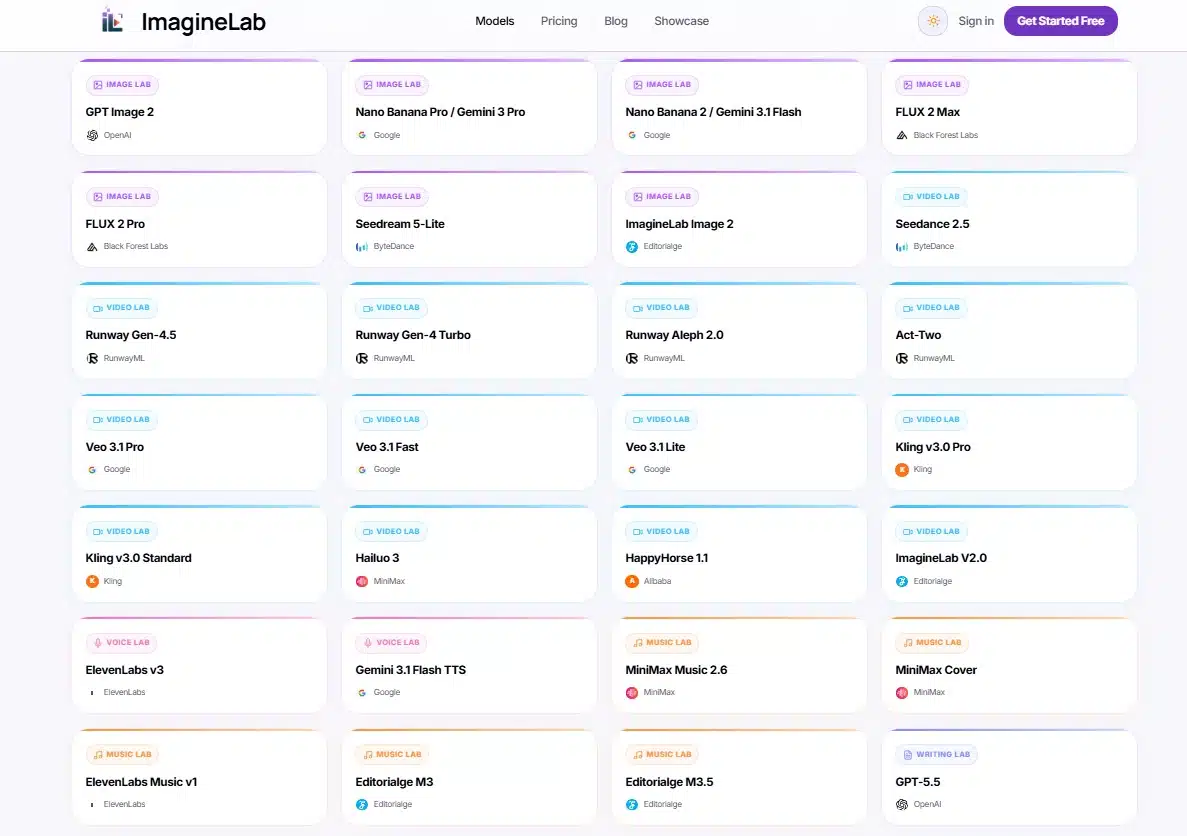
Opening the model selection settings reveals the full scale of the platform. A total of 36 premium AI models are distributed across the seven active labs.
Instead of routing every prompt through a single foundation model, ImagineLab Art combines engine technologies from leading industry developers alongside proprietary models built specifically for the platform.
AI Models in the Image Lab
The Image Lab offers OpenAI’s GPT Image 2, Google’s Nano Banana Pro and Nano Banana 2, Black Forest Lab’s FLUX 2 Max and FLUX 2 Pro, ByteDance’s Seedream 5-Lite, and Editorialge Media LLC’s proprietary ImagineLab Image 2 model.
Having access to diverse image models is important because no single architecture excels at every visual style:
- Photorealism: Specific models perform better when rendering lifelike photography and natural lighting.
- Commercial Graphics & Concept Art: Other engines offer sharper execution for marketing visuals, stylized illustration, product renders, and concept designs.
AI Models in the Video Lab
The Video Lab features an extensive collection of video engines, including Runway Gen-4.5, Gen-4 Turbo, Aleph 2.0, and Act-Two. Google’s Veo 3.1 is available in Pro, Fast, and Lite configurations.
Additional options include Kuaishou’s Kling v3.0 Standard and Kling v3.0 Pro, MiniMax’s Hailuo 3, ByteDance’s Seedance 2.5, Alibaba’s HappyHorse 1.1, and the proprietary ImagineLab V2.0 model from Editorialge.
Video generation is an area where engine choice directly impacts the final output. Key factors include:
- Rendering speed and frame stability
- Motion quality and subject tracking
- Character consistency across shots
- Visual realism and prompt adherence
- Input media support and credit consumption rates
Providing varied choices within one interface allows creators to select the best engine for a specific project without taking on a separate monthly subscription for every provider.
AI Models in Voice and Music Lab
The Voice Lab provides access to ElevenLabs v3 alongside Google’s Gemini 3.1 Flash TTS.
The Music Lab features Editorialge’s proprietary M3 and M3.5 models, MiniMax Music 2.6, MiniMax Cover, and ElevenLabs Music v1.
AI Models in the Writing Assistant and Infographic Lab
The Writing Assistant incorporates large language models, including OpenAI’s GPT-5.5, 5.6 Sol, and GPT-4o; Anthropic’s Claude Opus 4.8 and Claude Sonnet 4.6; and Google’s Gemini 3.1 Pro.
The Infographic Lab relies on supported visual models to create information designs, charts, comparison graphics, explainers, timelines, reports, and structured visual assets. It uses GPT Image 2.0, Nano Banana 2, Nano Banana Pro, Seedream 5-Lite, and the in-house ImagineLab Image 2 model to generate these outputs.
AI Models in Imagine Chat
Imagine Chat incorporates OpenAI’s GPT 5.6 Sol, Anthropic’s Claude Sonnet 5 and Claude Opus 5, as well as Google’s Gemini 3.5 Flash and Gemini 3.1 Pro.
In total, the platform aggregates model capabilities from developers including OpenAI, Google, Anthropic, Black Forest Labs, Runway, ElevenLabs, MiniMax, ByteDance, Kuaishou, and Alibaba.
For end users, the true benefit lies in flexibility rather than a list of brand names. An engine that suits one creative brief might fail on the next. ImagineLab Art is structured so creators can switch architectures without stepping outside their primary workspace. The platform also includes four proprietary models—ImagineLab Image 2, ImagineLab V2.0, Editorialge M3, and Editorialge M3.5—developed by its parent entity, Editorialge Media LLC.
EDT Tokens and Credit-Based Pricing
ImagineLab Art relies on a proprietary token system known as EDT (Editorialge Digital Token). Rather than requiring separate subscription plans for every media type, users maintain a single token balance that decreases as generations are completed.
This flexible credit system adapts to variable creator workloads. A user might consume tokens heavily during client deadlines and spend far less during quieter intervals. Additional EDT top-ups can be purchased as needed, avoiding the need for multiple fixed monthly bills.
| Plan / Option | Monthly Price | Included EDT Tokens | Key Plan Features & Output Estimates |
|---|---|---|---|
| Free Trial / Preview | $0 | 50 EDT (plus instant 1K image preview) | Allows visitors to test a 1K square image export without logging in. Verified sign-ups receive 50 EDT. |
| Starter Plan | $10 / month | 700 EDT | Entry tier; estimated for ~45 1K images or 5 short video clips depending on settings. |
| Creator Plan | $29 / month | 2,000 EDT | Adds full commercial rights; estimated for ~125 images, 14 short videos, 57 music tracks, 80 infographics, or 250 text tasks. |
| Pro Plan | $79 / month | 5,500 EDT + 100 EDT Bonus | Commercial rights, priority access queues, and faster processing speeds. |
| Studio Plan | $149 / month | 10,500 EDT | Targeted at small teams and production studios. |
| Business Plan | $249 / month | 17,500 EDT | Built for high-volume enterprise and agency production. |
Note: Choosing annual billing lowers the effective subscription cost by approximately 17%. Custom enterprise arrangements are also available for larger institutions and agencies.
Beyond base pricing, ImagineLab Art publishes estimated generation yields for its token packages. Evaluating token-based platforms can be challenging when users cannot translate abstract balances into practical deliverables. Outlining clear benchmark outputs—such as expected totals for images, video clips, audio tracks, infographics, or copy tasks—helps users make informed purchasing decisions.
Watermark-Free Exports Across All Tiers
A notable product policy choice is that ImagineLab Art does not add software watermarks to generated content, even on its free access tier.
This distinction is important for working professionals. A watermarked file prevents a concept from being presented to clients, embedded in presentation decks, added to professional portfolios, or published directly without additional editing.
Removing output watermarks makes the initial trial tier a functional testing ground rather than a restricted demonstration. Full commercial licensing rights kick in starting at the $29 Creator tier.
For independent freelancers evaluating the software for client work, the combination of commercial rights, pay-as-you-go token flexibility, and clean exports makes the $29 plan a key tier to consider.
Payment Support for Global and Regional Markets
ImagineLab Art has taken a distinct approach to its payment architecture. Beyond supporting standard international channels such as PayPal, Stripe, Visa, Wise, Mercury, and Mastercard, the platform integrates regional payment methods directly into its checkout system.
Unified Payments Interface (UPI) is fully supported for users in India and other eligible countries, while bKash is integrated for creators in Bangladesh.
While alternative checkout systems may seem less flashy than AI model launches, payment accessibility dictates whether a platform is practically usable in many parts of the world. Global creative tools are frequently built exclusively around international credit cards. In regions where these payment methods are less common, software can remain functionally inaccessible even if it is technically available.
ImagineLab Art treats localized payment support as a core product feature rather than an afterthought.
This payment localization is directly relevant to India and Bangladesh, two regions with rapidly growing populations of digital designers, video creators, agencies, publishers, developers, and freelance workers.
Native Local-Language Creative Templates
The same localization strategy applies to the platform's template library. Alongside standard global formats, creators have access to templates optimized for English, Bengali, Hindi, and regional content workflows.
For example, the library contains dedicated Bengali music prompts and templates, such as "Tumi Acho Dure," "Tomar Anando Tumi Kore Jao Tai," and "Tumi Sei Brikkho," as well as templates tailored for Hindi and Bhojpuri content creation.
Technical language compatibility is fundamentally different from building product workflows tailored to specific cultural user bases.
Offering localized templates shows an intentional effort to support regional creative outputs rather than relying solely on automated translation. The complete library contains over 100 structured starter templates spanning image, video, music, and infographic categories.
For creators who prefer not to start every assignment with a blank prompt box, these pre-structured starting points accelerate the path from initial concept to completed deliverable.
Community Features Integrated into the Workspace
ImagineLab Art is also addressing an area that many creative software platforms overlook: giving creators reasons to remain on the platform after downloading their assets.
Its built-in community hub features active creative challenges, platform rewards, and public leaderboards organized on weekly and monthly intervals.
Standard generation platforms typically follow a transactional loop: users enter a prompt, wait for output generation, save the local file, and exit the application. ImagineLab Art aims to foster an active community experience where members can participate in design challenges, review community creations, compete on public leaderboards, earn token rewards, and collaborate on troubleshooting creative issues.
The long-term impact of this hub will depend on user adoption over time, but the underlying concept aligns with how creative work happens in practice. Skill development frequently occurs by reviewing peer workflows, comparing output parameters, sharing prompt techniques, and exchanging feedback. A strong built-in community can function as both an engagement tool and an educational resource for mastering the workspace.
Conversational Generation via Imagine Chat
Imagine Chat offers conversational AI assistance within the unified production workspace. Rather than isolating chat interactions in a separate tool, the feature functions as an entry point into the wider creation environment.
Users can start with an unrefined idea instead of a fully formed prompt. The chat assistant helps refine concepts, plan campaign structures, establish visual styles, draft copy options, or select appropriate generation tools.
Positioning Imagine Chat alongside early creative decision-making supports the platform's core workflow model: creators can outline ideas using everyday conversational language and translate those concepts directly into production steps.
Future Roadmap: Music Video, Long Video, and Ad Creative Studios
The current global launch represents the initial phase of the company's planned product roadmap. Music Video Lab, Long Video Lab, and Ad Creative Studio are actively being developed for subsequent feature releases.
- Music Video Lab: Designed to bridge audio generation with automated video synthesis.
- Long Video Lab: Intended to extend platform capabilities beyond short video generation toward longer narrative formats and extended production pipelines.
- Ad Creative Studio: Tailored for marketing agencies, brand teams, and advertisers needing complete, multi-format campaign packages rather than standalone images or copy.
These additions aim to expand ImagineLab Art into an end-to-end ecosystem capable of supporting creative projects from early brainstorming to final multi-format distribution.
API Integration for Developers and Teams
ImagineLab Art extends its capabilities beyond its web interface by offering a REST API for developers and commercial enterprises looking to integrate its AI services into custom software applications.
The API uses standard bearer-token authentication alongside scoped API keys. Higher-tier pricing options are built to support white-label deployments and enterprise integrations.
- Marketing Agencies: Can connect platform generation pipelines directly into internal campaign software.
- Publishing Houses: Can integrate visual asset generation straight into existing content management workflows.
- SaaS Developers: Can expose selected generative tools within their own customer-facing products without requiring users to process files manually through the ImagineLab Art dashboard.
Providing API access turns the platform into both a standalone web workspace and an underlying infrastructure layer for third-party software.
Executive Leadership and Management Team
ImagineLab.art operates as a subsidiary of Editorialge Media LLC, marking a major step in the firm's growth strategy as it expands from digital publishing into software technology development.
- Sukanta Kundu Parthib: Founder and Chief Executive Officer (CEO) of ImagineLab Art and Editorialge Media LLC.
- Aushnik Das: Deputy Chief Executive Officer (Deputy CEO) and Chief Operating Officer (COO).
- Tapos Kumar: Acting Chief Technology Officer (CTO) and Chief Project Coordinator.
- Sayedul Haq Mihir: Chief Technical Advisor.
- Md. Ahsanur Rahman: Lead Full-Stack Engineer and Head of Research and Development (R&D).
Practical Market Value of Platform Consolidation
The digital landscape already contains numerous individual creative apps. ImagineLab Art was designed specifically to address the operational issues caused by that tool sprawl. The challenge for modern creators is rarely a lack of available software, but rather the inefficiency of managing too many isolated services.
A visual designer may rely on one service, a video team on another, a voiceover provider on a third, and a music generator on a fourth. Writing tools, infographic builders, and ad creative generators add even more recurring bills to the mix.
This tool fragmentation carries financial costs along with operational friction. Repeated user logins, disparate billing schedules, isolated token systems, mismatched prompt inputs, constant asset uploads, and manual file conversions disrupt production focus.
ImagineLab Art is betting that consolidating these tools creates real operational value. Rather than trying to force every prompt through a single proprietary engine, the workspace aggregates diverse model options into one interface, allowing creators to select the best tool for every project step.
This setup offers a pragmatic approach to generative software. The platform does not require users to rely exclusively on one AI model; instead, it provides direct access to the right engine for the task without forcing creators to redesign their production workflow every time.
Target User Groups and Key Use Cases
Freelancers represent one of the clearest initial target audiences for the platform. Freelance workloads rarely stay confined to a single content format; a client might require promotional graphics today, a short social video clip tomorrow, a voiceover track next week, and marketing copy throughout the project lifecycle.
Small creative agencies face these same multi-format production demands on a larger scale. Similarly, media publishers routinely generate articles, visual explainers, video clips, podcast audio, social media graphics, and display ads to accompany a single story.
Marketing teams also switch constantly between written copy, image creation, video editing, background audio, and slide presentations. For these users, a consolidated workspace offers operational value by removing friction between creative steps.
Furthermore, creators in regions like India and Bangladesh gain access to localized payment processing systems that are often missing from major international software platforms.
Combining UPI and bKash payment support, local-language templates, international payment flexibility, and global AI model access makes ImagineLab Art well-positioned to serve a broad international user base.
Core Questions for Platform Evaluation
ImagineLab Art must now prove that combining a broad set of generative tools into one dashboard delivers tangible efficiency gains for everyday creators. Key practical considerations include:
- Can users transition smoothly from image generation to video production without unnecessary export steps?
- Can freelancers handle client deliverables without paying for multiple separate subscriptions?
- Can regional users pay for software tiers without resorting to complex payment workarounds?
- Can creative teams manage an unified token balance without sacrificing production flexibility?
- Can developers successfully build platform features into third-party apps via the REST API?
Answering these operational questions will matter far more than evaluating feature lists on a marketing page. The setup allows users to test the workspace without upfront commitments: new verified accounts receive 50 free EDT tokens, and visitors can test a 1K square image generation preview directly on the platform before signing in.
This offers a straightforward path for evaluation: import an active project, run it through your standard creative workflow, and determine how much of the work can be completed within a single workspace.
Source: Editorialge